


Amogh Dev Rai | Research Director and researcher on China, and Chinese Geopolitics.
The remark wasn’t about Taiwan; that’s what makes it useful to Beijing
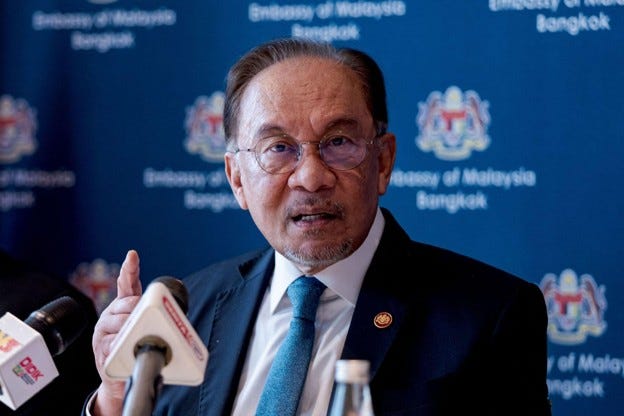
Anwar Ibrahim spent his Thursday (20th August) defending a position on Chinese reunification at a press conference after a TikTok Shop retail summit in Kuching. The Prime Minister launched the convention, presumably took questions on live commerce and small business onboarding, and then had to explain, again, why he told Al Jazeera in an interview with Sreenivasan Jain four days earlier that he’d use force to stop a Malaysian province from breaking away, and that Beijing was entitled to do exactly the same thing to Taiwan.
Sreenivasan Jain asks him, would he condemn China for reserving the right to use force on Taiwan. Anwar doesn’t think twice. He reaches for Malaysia itself as an example, a province deciding to break away, and says he’d do exactly what Beijing says it would do. Pressed on whether that means force, he doesn’t dodge it either. “Because otherwise they’ll be fragmented,” he says, which is about as close as a sitting head of government gets to saying that war might not be the last resort but the first choice.
Most countries that recognise Beijing over Taipei do it through the standard formula: acknowledge, note, respect, a whole vocabulary engineered to avoid saying anything with actual teeth in it. Anwar went straight to the premises underneath it. Not just that Beijing has the right, but that using it would be obviously correct, the same thing any government would do in the same situation.
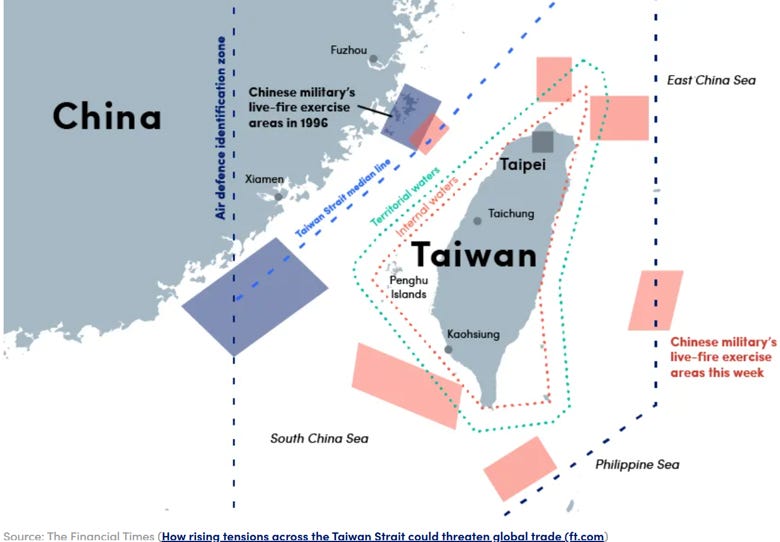
China loved it, predictably. Lin Jian, at Wednesday’s briefing, said Beijing was pleased, grateful even, for what Anwar had said, then ran through the usual lines, inalienable territory, unstoppable historical trend. Global Times had an academic from Xiamen on by Wednesday evening, making the case that Anwar’s remarks prove the international consensus is already settled, and that any government with its own separatist headache should probably draw the same conclusion he did.
Taiwan’s foreign ministry took the opposite read, called it a threat to regional stability, and said it could cost Malaysia investment from Taiwanese businesses. The DPP called it false. None of it moved Anwar. By Thursday, he was standing by every word, pointing to the United States of America’s own history of refusing to let states secede, no country just lets a piece of itself walk out, and suggesting the whole thing was really about how Al Jazeera had framed the question rather than anything he’d actually said.
Which, technically, is true. Malaysia’s one China position isn’t new; it goes back to 1974, the joint communique under Tun Abdul Razak, Malaysia recognising the PRC as the sole legal government and Taiwan as part of its territory. Every government since has repeated some version of it. So Anwar’s defense holds up fine on the facts. What actually changed wasn’t the position. It was the volume.
And that’s the part worth sitting with, because the Taiwan line wasn’t really the point he was making. Go back to the interview itself. It comes up inside a longer answer about what Anwar calls Western hypocrisy, double standards on Gaza, and international law applied depending on who’s the one breaking it. Taiwan was the analogy he reached for to make a completely different argument, about consistency, about who gets to invoke territorial integrity and who doesn’t. He wasn’t working out a considered position on cross-strait sovereignty. He was making an analogy about the broken international order.
Which is, if we’re honest, roughly how China picks up most of its endorsements on this question. Nobody sits down and independently derives that Taiwan is a province of China. What happens instead looks a lot like this week: a leader mid-argument about something else reaches for an analogy, and the analogy happens to do Beijing’s work for it. Do that enough times, across enough interviews, across enough years, and you get what Lin Jian calls an unstoppable historical trend, which on closer look is really just an accumulation of exactly this kind of borrowed logic, tidied up afterward into something that sounds like consensus.
Anwar gets something out of the exchange too. China is Malaysia’s largest trading partner, and with this statement, an ever-grateful Chinese state might consider bolstering trade relations. It costs him nothing domestically, Malaysia doesn’t have a live secession movement worth the name, so the analogy was free to make and useful to have made. Whether that was calculated going in or just where his own rhetoric happened to land him, it’s hard to say from the outside. Probably doesn’t matter much to Beijing either way. They have got a new endorsement in the bank.
Produced by Decypher Team in New Delhi, India