


The Reef That Ate the Order
China is not building an island. It is building a thesis — that the American security architecture in Asia has a structural defect, and the Iran war just proved it.
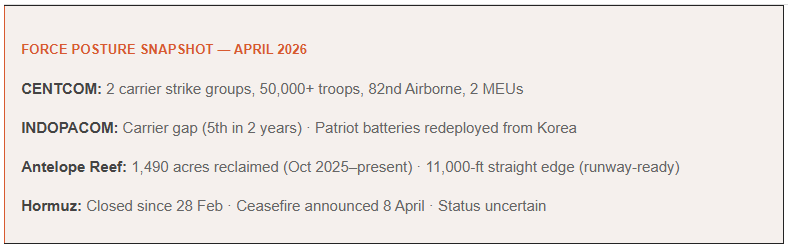
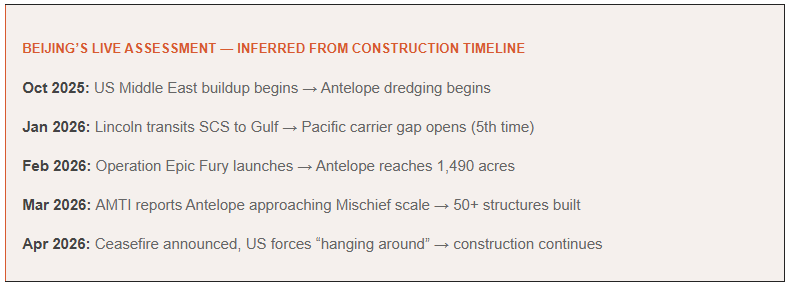
Five months ago, Antelope Reef was a sandbar. Two buildings and a jetty. One of the smallest features in Beijing’s Paracel portfolio — a footnote on Chinese charts, invisible on everyone else’s. Today it is 1,490 acres of reclaimed land, nearly the size of Mischief Reef, the largest Chinese outpost in the South China Sea. The northwestern edge runs straight for over 11,000 feet. That is not an accident. That is a runway.
Land reclamation at Antelope Reef
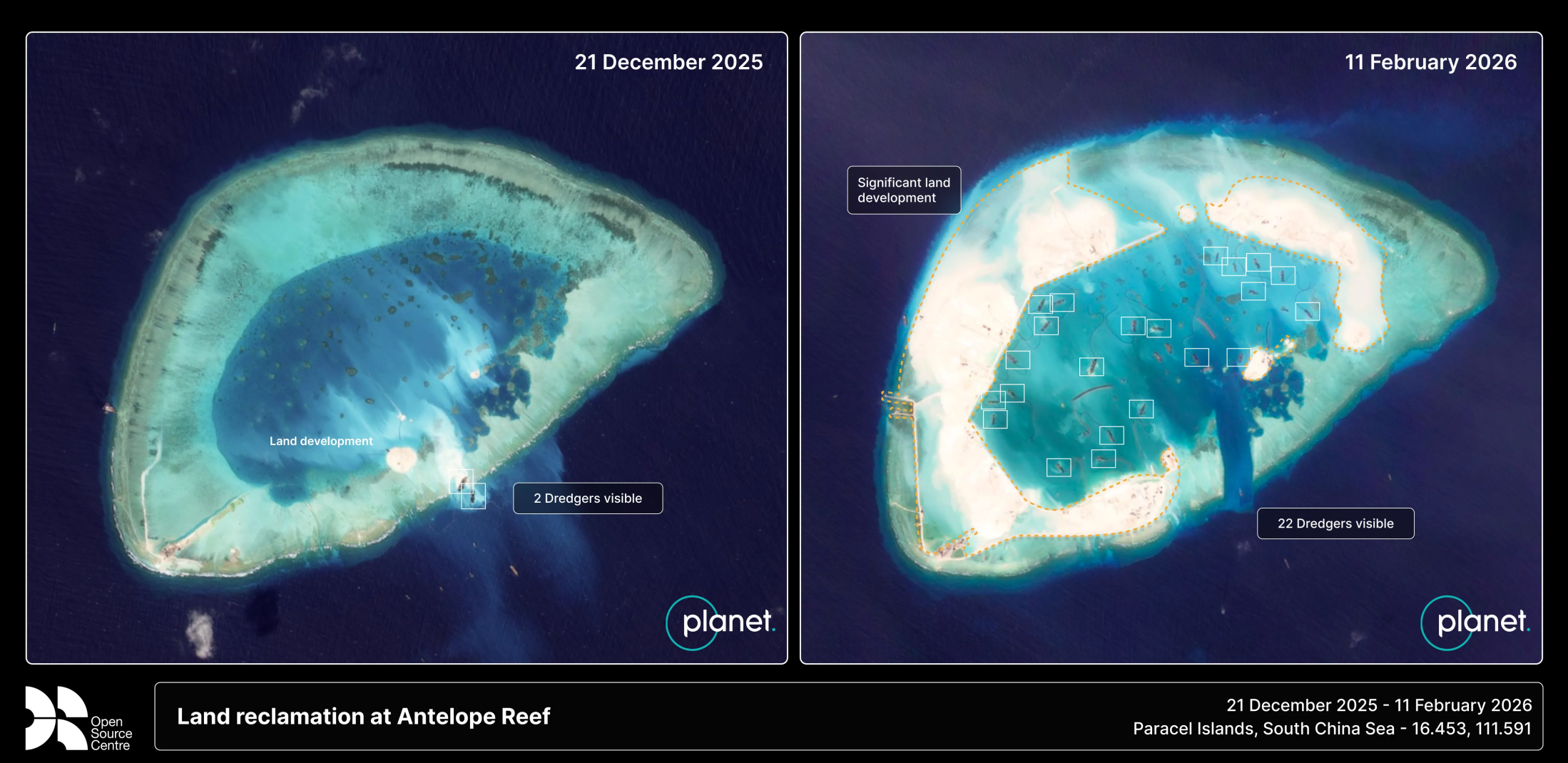
The timing should be the lead. Dredging began in October 2025, the same month the US began repositioning assets toward the Gulf. The Abraham Lincoln transited from the South China Sea to the Gulf of Oman in January. Patriot batteries redeployed from South Korea to the Middle East. By late February, when Operation Epic Fury opened with the assassination of Khamenei and the largest US air campaign since 2003, the Pacific had no carrier presence at all. It was the fifth such gap in two years. Each time the gap opened, the construction window widened. This time, China drove a reef through it.
None of this required conspiracy. It required a calendar.
The conventional read — and it is not wrong, just insufficient — is that Beijing exploited a distraction. The US was looking at Tehran; China built an island. There is something to this. The CSIS Asia Maritime Transparency Initiative noted that Antelope Reef represents the first significant artificial island-building China has undertaken in the South China Sea since 2017. The pause lasted seven years. It broke the moment American attention went elsewhere. That is not a coincidence. But it is also not the whole picture.
The deeper bet is structural. What China is testing is not whether the US will notice Antelope Reef. (It has.) It is whether the US can do anything about it while maintaining a credible presence in the Gulf, honouring its commitments in Europe, and sustaining the political will to contest a reef in a sea most Americans cannot locate on a map. The answer, so far, is no. And Beijing now has the evidence in real time.
The Iran war did not create the vulnerability. It measured it. Antelope Reef is the structure built inside the measurement.
This is the part that matters for the next decade of Asian security. Operation Epic Fury gave Beijing something it could not have obtained any other way: a live, high-definition assessment of American force-projection capacity under stress. Not a wargame. Not a think-tank simulation. An actual war, with actual redeployments, actual logistics chains, actual political constraints. The results are legible from satellite imagery alone. The US committed two carrier strike groups, 50,000 troops, the largest air force deployment since Iraq 2003, ground forces from the 82nd Airborne, two Marine Expeditionary Units — and still needed an extension to compel Iran to discuss reopening the Strait of Hormuz. Hegseth confirmed yesterday that American forces will be “hanging around” the Middle East through the ceasefire and beyond.
That phrase — hanging around — is the quiet part. Every day a carrier group hangs around the Gulf is a day it is not in the Philippine Sea. Beijing does not need to defeat INDOPACOM. It needs to exhaust the rotation.
Plot this on the Chaos Map — the framework for locating actors between order and chaos, relational and conceptual pattern-making — and the architecture becomes visible. The Iran war sits deep in relational chaos: kinetic, volatile, consuming. It is a gravity well. Everything near it — US assets, attention, political bandwidth — gets pulled in. China, by contrast, operates in the opposite quadrant: conceptual order. Methodical. Institutional. Arrow-motion. Antelope Reef is not a provocation. It is infrastructure for a thesis about what comes after the American security guarantee in Asia proves itself unable to hold two theatres at once.
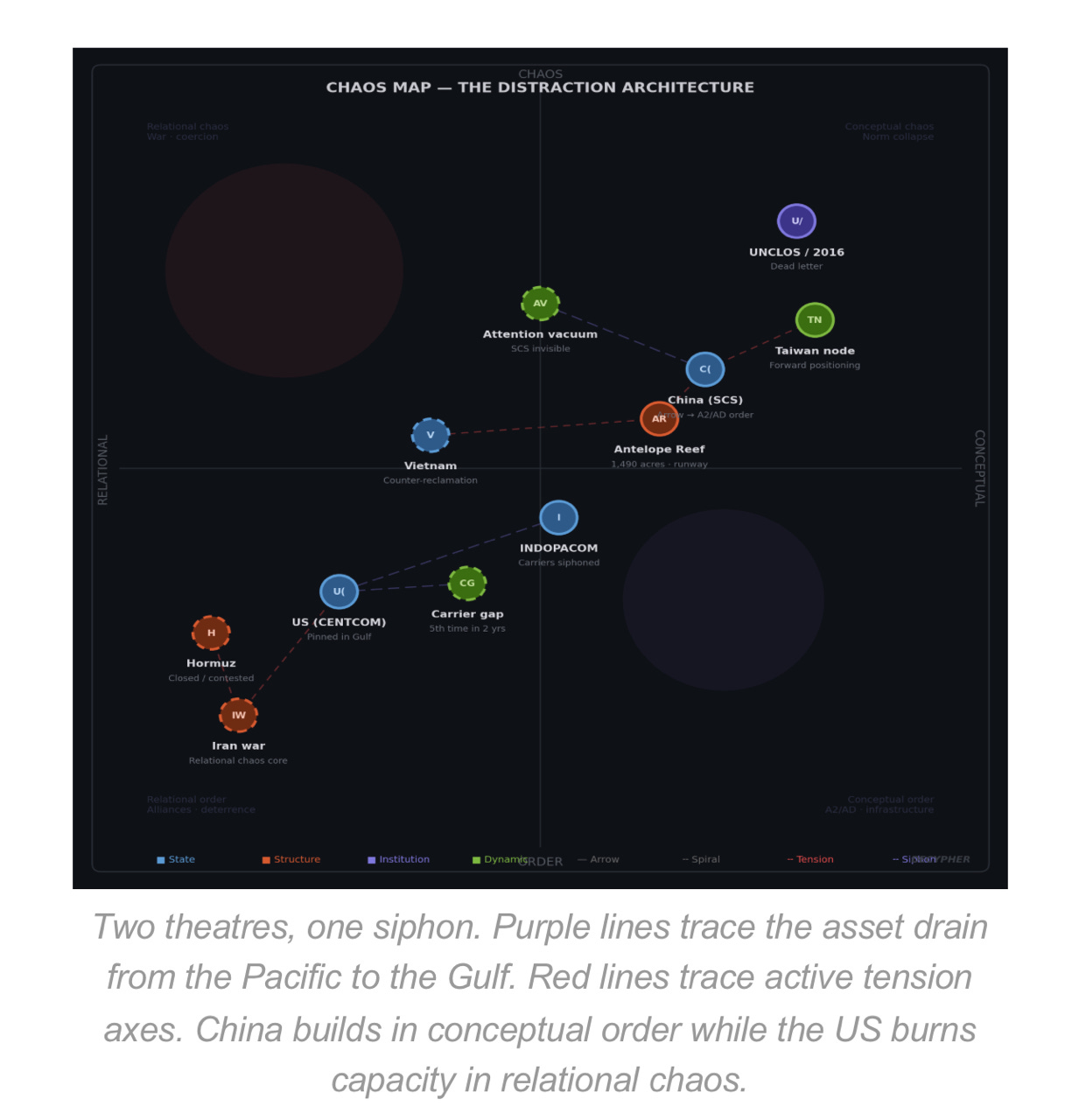
The map splits cleanly. On the left: Iran, Hormuz, CENTCOM — relational chaos, spiral motion, consuming everything near them. On the right: China, Antelope Reef, Woody Island, the Taiwan contingency — conceptual order, arrow motion, building toward an endpoint. The siphon lines connecting them are the map’s real finding. They trace the carrier rotations, the Patriot redeployments, the attention hierarchy that makes a reef in the Paracels invisible while a war in the Gulf fills every screen.
There is a third actor on the map that receives too little attention: UNCLOS and the 2016 Permanent Court of Arbitration ruling, which declared China’s nine-dash line invalid. It sits in conceptual order but exerts no gravitational force on the conflict cluster. The legal framework exists. It constrains nothing. That gap between the law on the books and the sand in the water is itself a data point in Beijing’s thesis: the rules-based order is a phrase, not a physics.
Woody Island Air Base
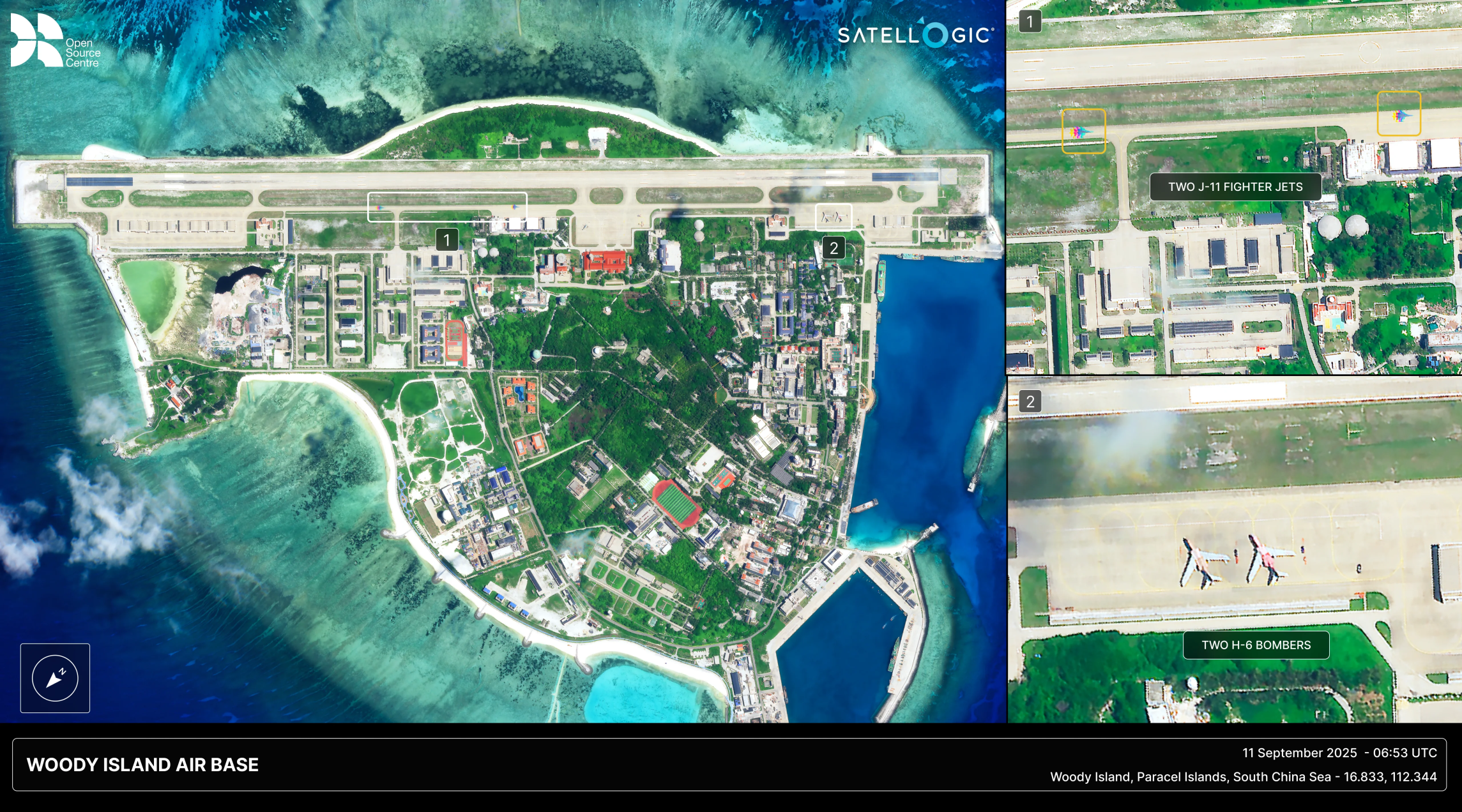
What makes this moment different from the 2013–2017 island-building campaign is not scale. It is confidence. The first campaign was a gamble — Beijing pushed and waited to see if anyone would push back. Obama didn’t. The current campaign is not a gamble. It is an execution. Beijing has now watched the US fight (or try to end) a war in real time. It has seen the logistics chains, the carrier rotation timelines, the political dynamics of escalation and de-escalation, the fragility of the Strait of Hormuz chokepoint, the inability to close a theatre quickly. It has watched the 82nd Airborne deploy to a war that may or may not require ground forces, and it has watched the Pentagon simultaneously lose carrier coverage in the Pacific.
This is intelligence you cannot buy. Iran gave it away for free.
The analytical class in Washington is aware of this problem. The CSIS report on Antelope flags the scale. CNN, the Wall Street Journal, Defence News have all covered the construction. But coverage is not the same as response. The structural issue is that the US force posture is built for a world in which major theatre conflicts are sequential. The Middle East first, then pivot to Asia. The 2011 Obama pivot. The 2018 Trump NDS. The logic assumes you can finish one before the other starts. What the Iran war has demonstrated — and what Antelope Reef has capitalised on — is that adversaries do not wait for your pivot. They build during your distraction. The conflicts are simultaneous, and the force structure is not.
Beijing’s thesis is simple: the American order in Asia is a scheduling problem. And scheduling problems, unlike ideological ones, cannot be solved with resolve. They require mass. The US does not have it.
Vietnam is the only regional actor offering a physical counter. Hanoi has dredged 13.4 square kilometres across its 21 Spratly features since 2022 — a significant acceleration. But Vietnam operates in spiral motion: reactive, uncoordinated with any legal or institutional framework, constrained by its own relationship with Beijing. It cannot replace the missing carrier.
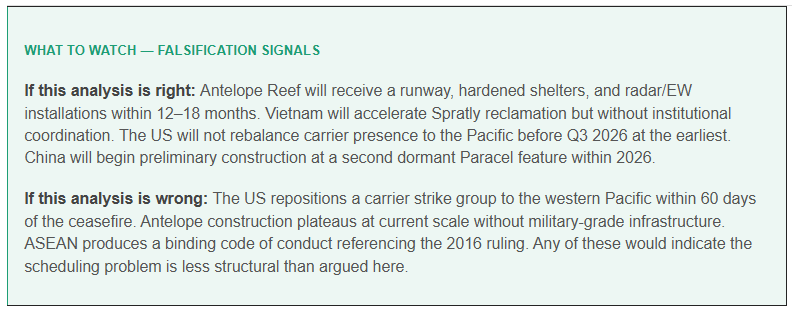
The deeper question — the one the Chaos Map framework makes legible but does not answer — is whether Antelope Reef is a local play or a systemic one. If local, it is an enhancement of the Paracel network: another runway, another radar array, another coast guard berth. Significant but containable. If systemic, it is a node in a forward-positioned architecture optimised for a Taiwan contingency, 162 nautical miles from Sanya, capable of hosting the surveillance, electronic warfare, and A2/AD assets that would complicate any US intervention in the Taiwan Strait. AMTI’s analysis leans toward the latter. So does the geometry. A reef shaped with an 11,000-foot straight edge facing the open sea is not a coast guard station. It is a denial platform.
Here is what I think Beijing has concluded from the past six weeks. Three things.
First: the US can destroy a military, but it cannot close a theatre. Iran’s military is “combat ineffective for years to come” (Hegseth’s words). And yet Hormuz remains contested, the ceasefire is two weeks long, and American forces will “hang around” indefinitely. Destruction is not resolution. The US creates power vacuums faster than it fills them. Beijing has noted this.
Second: the US political system cannot sustain two simultaneous confrontations. The Iran war consumed the entire political bandwidth of the administration — State of the Union, ceasefire theatrics, Kharg Island scenarios, the 82nd Airborne deployment drama. There was no bandwidth left for a reef in the Paracels. Not because no one saw it. Because the attention economy of American democracy is zero-sum in a way that China’s decision-making architecture is not.
Third: the force structure confirms the thesis. Two carrier strike groups in the Gulf means zero in the western Pacific. This is not a failure of strategy. It is a mathematical fact about the number of carrier groups the US operates (eleven, of which perhaps six are deployable at any given time) versus the number of theatres in which credible presence is required (at least three: the Gulf, the western Pacific, and European waters). You cannot cover three theatres with six rotational carriers. You can cover one and a half. Beijing has now watched this equation play out in real time, and it has started building accordingly.
The post-American order in Asia will not arrive with a declaration. It will arrive with infrastructure. A runway here, a radar installation there, a lagoon dredged deep enough for submarines, a reef turned into an island turned into a base turned into a fact. The 2016 ruling said China’s claims were invalid. Antelope Reef says the ruling is irrelevant. Both statements are true. Only one of them is made of concrete.

China–Iran Oil Trade: How the System Works
The Big Picture
US sanctions have long aimed to cut off Iran’s oil revenues, yet Tehran continues to generate billions — largely because Beijing has stepped in as its most reliable customer. A decade ago, China accounted for a relatively small share of Iranian crude purchases. That figure has since climbed dramatically, with estimates suggesting China took in over 1.4 million barrels daily in 2025, representing the overwhelming majority of everything Iran managed to sell.
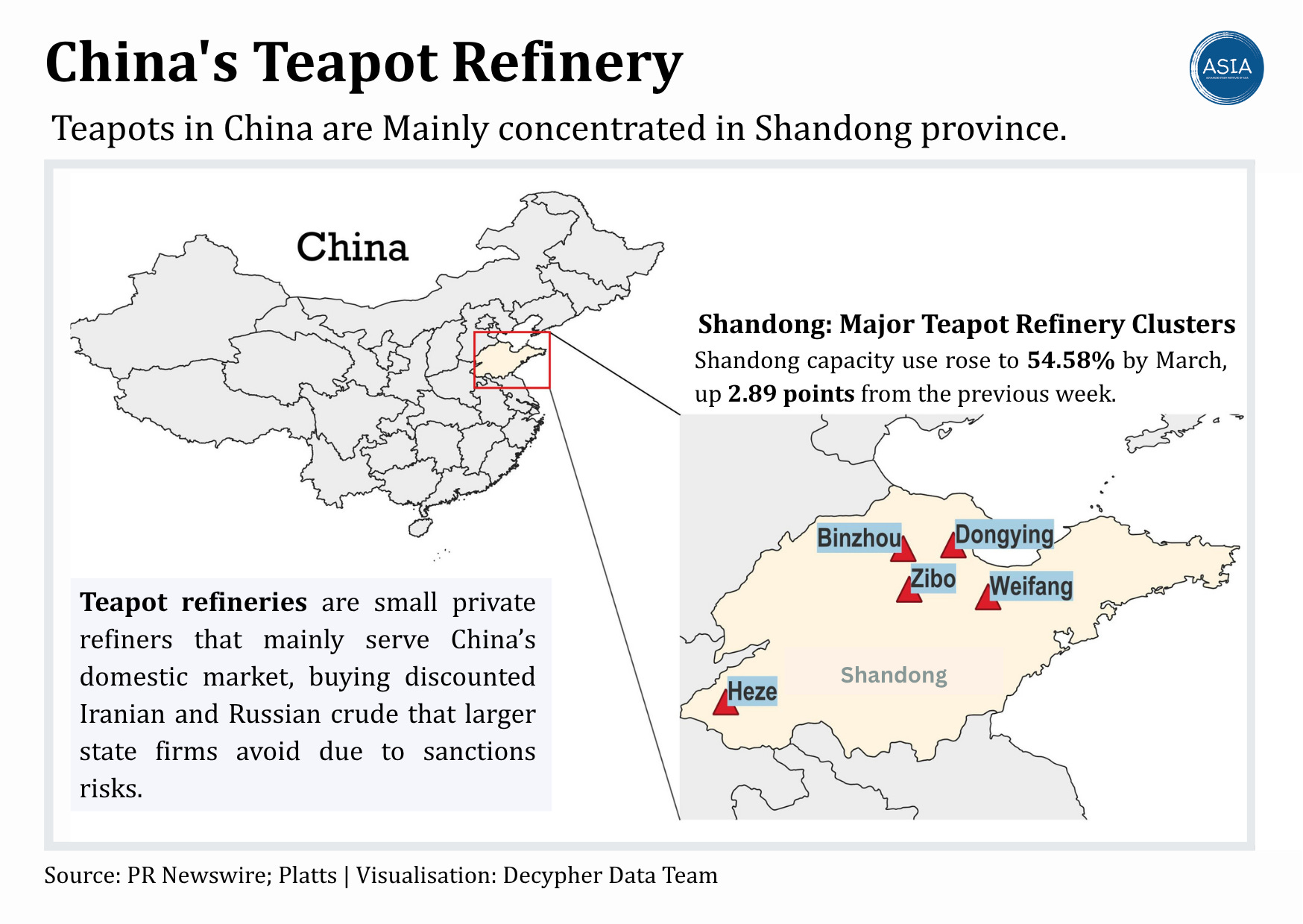
The engine behind this shift is a network of small, privately-run Chinese refineries — known as "teapots" — that mainly serve China's domestic market, buying discounted Iranian and Russian crude that larger state firms avoid due to sanctions risks.
While major state giants like Sinopec quietly withdrew from Iranian purchases to protect their international standing, teapot refineries moved in the opposite direction. Operating with fewer regulatory constraints and settling payments in yuan rather than dollars, they became the backbone of a trade that Washington struggles to disrupt.
How the Network Stays Hidden
Moving sanctioned oil across oceans requires more than just willing buyers. Tankers routinely disable their tracking systems, assume new names, and offload cargo onto different vessels mid-voyage before reaching Chinese ports. By the time a shipment is documented, its listed origin is often a completely different country — Malaysia or Oman rather than Iran.
How China’s Teapot Refineries Bypass Sanctions
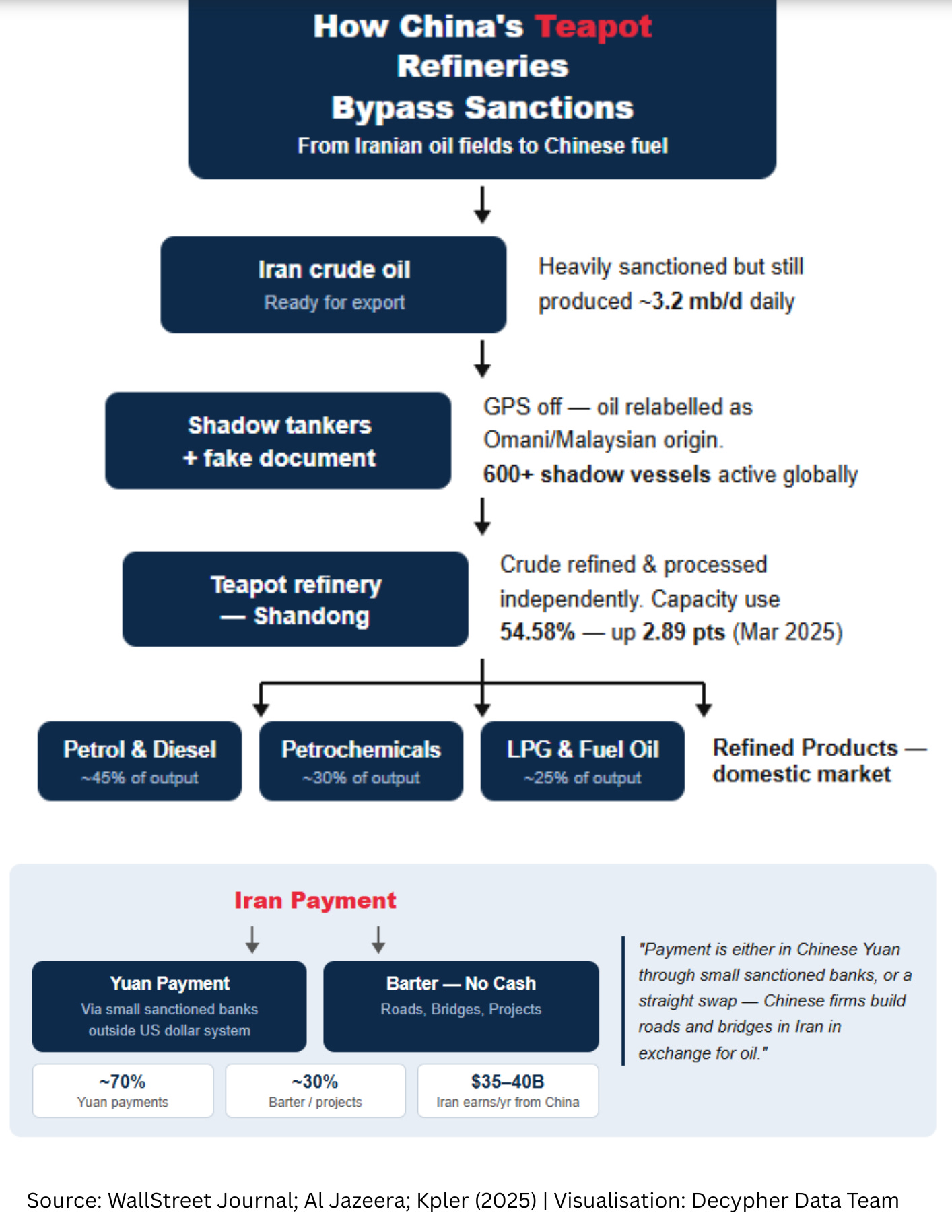
Layered on top of this are shell companies, frequently registered in Hong Kong, that handle the paperwork and channel payments. Meanwhile, Beijing’s official trade figures have shown no Iranian crude imports since 2023 — a statistical fiction that serves as a diplomatic buffer with Washington while the oil continues to flow.
How the Money and Strategy Work
With major global banks unwilling to touch Iran-related transactions, payments are funnelled through smaller Chinese financial institutions that have little international exposure to protect. Bank of Kunlun, already cut off from the US financial system since 2012, has served as one such conduit.
Cash, however, isn’t always part of the equation. Chinese firms have constructed roads, bridges, and other public infrastructure inside Iran, receiving oil in return. These barter arrangements — bypassing currency transfers entirely — were valued at roughly $8.4 billion in 2024.
For China, the calculation is straightforward. Below-market oil prices, a secure supply during periods of global instability, and growing leverage in the Middle East all serve Beijing’s interests — while simultaneously blunting Washington’s pressure on Tehran.
The Larger Meaning
The US has not stood idle. Sanctions have been expanded, indictments filed, and specific refineries and intermediaries targeted. But a full confrontation with China remains off the table — the risk of oil price shocks and a deeper breakdown in bilateral relations is simply too high.
What started as a workaround has become a well-oiled machine. Today, a network of private refineries, hidden tanker routes, small banks, and front companies keeps Iranian oil moving and both countries quietly benefiting — despite some of the toughest sanctions in history.

Taiwan Meeting China

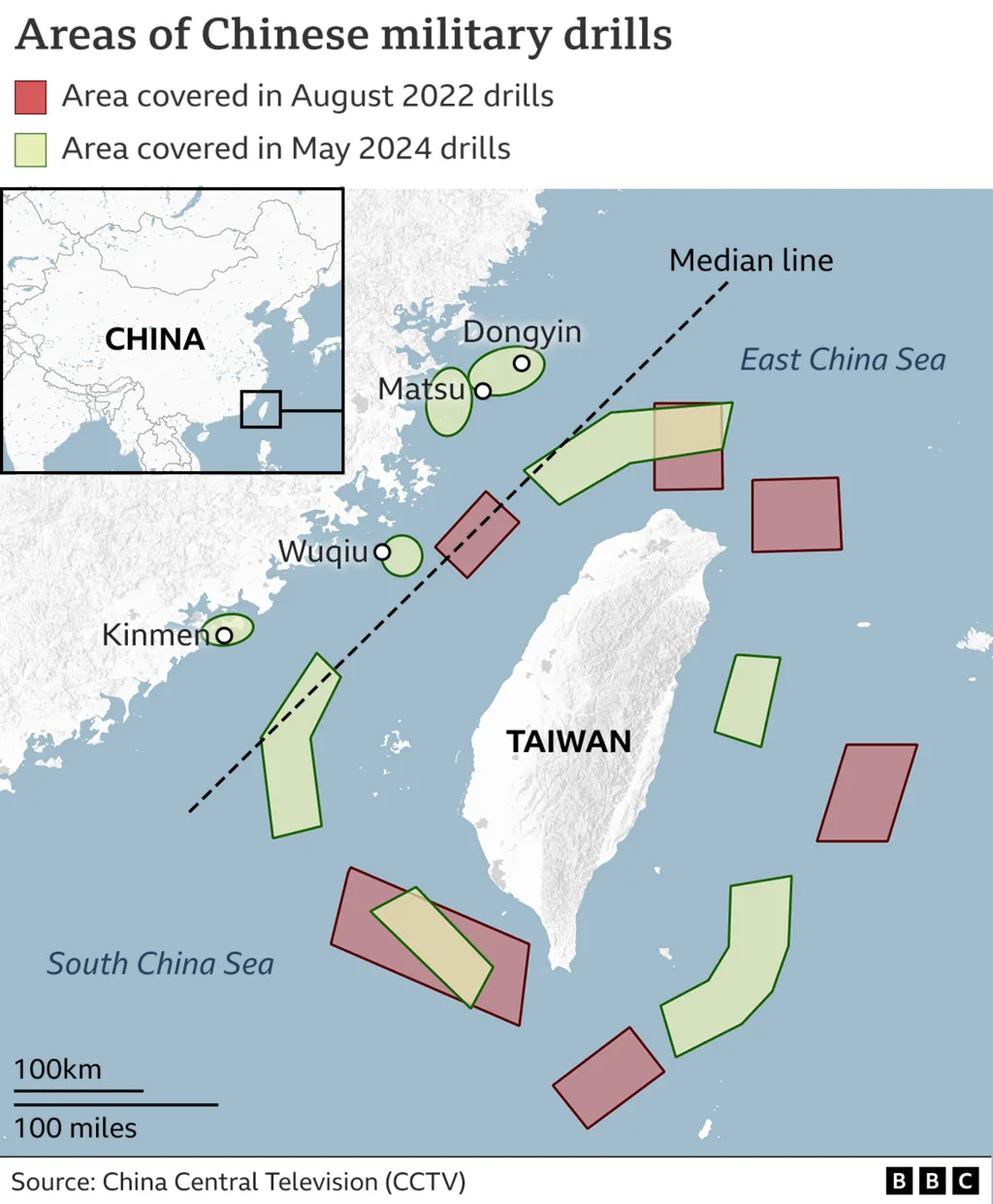
Beijing has long declared Taiwan as part of its own territory — not through negotiation, but through the language of carrier groups, missile drills, and airspace incursions. Against this hardening backdrop, a rare diplomatic gesture has emerged from an unlikely quarter.
Cheng Li-wun, Chairwoman of Taiwan's oldest political institution — the Kuomintang (KMT), once the ruling party of the Republic of China itself led by Sun Yat-Sen and later Chiang Kai-shek. Cheng Li-wun mission: to quietly lower the conflict that Taipei's current administration cannot, because Beijing will not speak to it. Cheng is the first sitting leader of KMT to make her visit China in a decade. The leaders of the two parties are meeting in Beijing to safeguard the peace and stability and development of cross-strait relations. Xi claims that those on both sides of strait are Chinese and all they want is peace.
China severed formal dialogue with President Lai Ching-te, branding him a separatist and a trouble maker. Falling ties of Taiwan with China after 2016, after the ruling party of Taiwan DPP gave their refusal to the concept of single Chinese nation. On the contrary, Her words, chosen with the precision of a poet navigating a minefield, were telling: "The skies should be for birds, not missiles." A sentiment elegant in its simplicity, radical in its context.
Yet the peace mission carries a shadow from home.
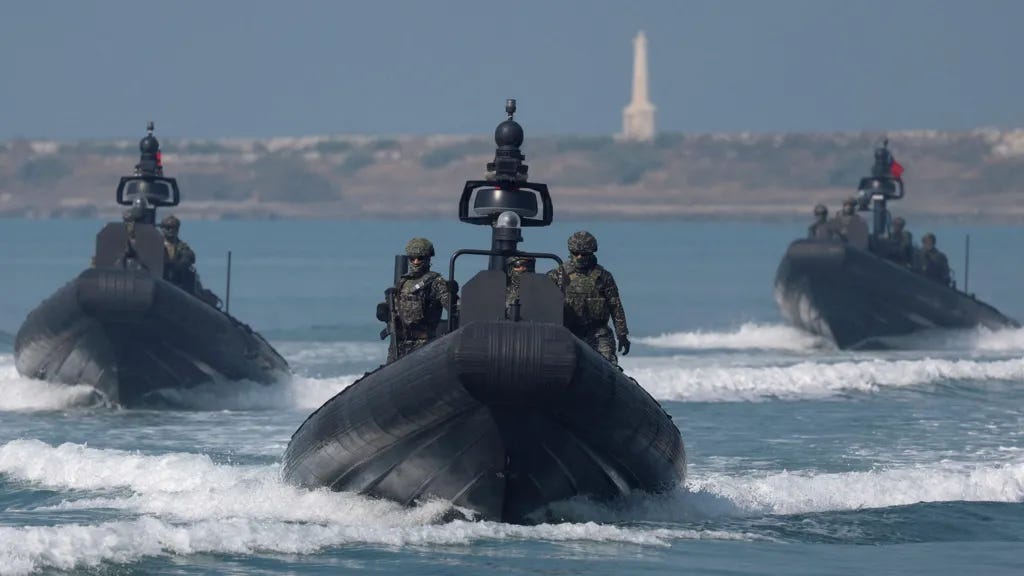
Taiwan's ruling Democratic Progressive Party (DPP) has questions for the opposition party — interpreting it less as diplomacy and more as political theatre that undermines national resolve. At stake is a proposed $40 billion defence expansion, in terms of missile systems, naval and air capabilities, cheaper and smart defence power, and military reserves stalled in the Legislative Yuan, where cross-party consensus remains elusive. The KMT's hesitation to fast-track military spending has fuelled accusations of softness, even collusion, from DPP quarters. Thus, it will be interesting to see how Taiwan is negotiating with China through two domestic logics and ideas.
— — —
Essay: Amogh Dev Rai- Research Director at the Advanced Study Institute of Asia (ASIA), affiliated with SGT University, Gurugram.
Microessay: Bhupesh
Data and Postscript: Neeti and Bhupesh
Produced by Decypher Team in New Delhi, India
— — —